
 The most expensive sentence in marketing
“I think our audience will like this.”
Those eight words have cost South African businesses millions of Rands. They usually come at the start of a long and well-meaning process: months of scripting, rounds of edits, executive sign-offs, and finally a launch where the result is treated as pass or fail. If it works, the team celebrates. If it doesn’t, the budget is written off and everyone says social media doesn’t work for their category.
The platform was never the problem. The model was. Algorithms on TikTok, Meta and LinkedIn do not care about production value. They care about whether people keep watching, engage and act. When you run one creative, you are placing your whole budget on one hypothesis and finding out whether you were right only after you’ve paid for it.
This article explains the alternative. It is the engine we run for every client, and you can use the logic in your own business even if you never work with us.
Older digital playbooks put the effort into audience selection: lists, lookalikes, narrow interest stacks. On short-form video that has changed. Platforms now find the right people largely by reading how audiences respond to the content itself. Your hook, your creator and your edit tell the algorithm who to show the ad to.
So creative is no longer a finishing touch applied after the strategy. It is the strategy. And if creative is the lever, the sensible response is to test it constantly rather than polish it once.
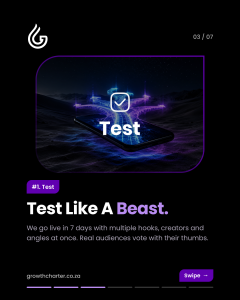 Step 1: Test Like a Beast
The first seven days after brief sign-off are about learning as much as possible, as cheaply as possible. We deploy a high-volume testing matrix across channels, and the structure matters more than the volume.
An illustrative example: a retailer launching a seasonal offer might test a price-led hook, a problem-led hook, a before-and-after hook, a question hook and a social-proof hook, each filmed by a younger creator, a mid-career creator and the founder. That is a lot of assets, but each one costs a fraction of a studio shoot, and together they answer the question “what works for this audience?” in days.
Do not judge week-one creative on sales alone. Early on, look at three-second view rate, average watch time, CTR and cost per click. These indicate whether the hook holds attention and whether the offer earns the click. Conversion data then tells you which of the attention-winners also persuade.
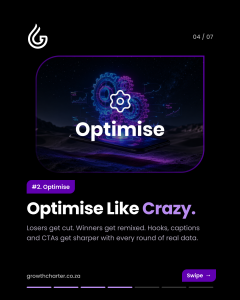 Step 2: Optimise Like Crazy
Testing only pays off if you act on the results quickly. Optimising means being ruthless with losers and generous with winners.
If a video shows weak retention, we pause it. Not after another week, and not because someone on the client side is fond of the concept. A weak asset that keeps spending is not a learning, it is a leak.
Cutting early frees budget for the assets that deserve it.
Winning creative is raw material. We take a hook that holds attention and pair it with new body footage. We keep a strong body and try fresh openings. We adapt the winning concept across platforms, so a TikTok hook may become a Meta Reel or a LinkedIn short. Each remix is a cheap new test built on proven ground, which is far more efficient than starting from a blank page.
The most valuable output of optimisation is the pattern behind the results. If three winning hooks all open by naming a specific frustration, that is a creative principle for your brand. We log these patterns so the next sprint starts smarter than the last.
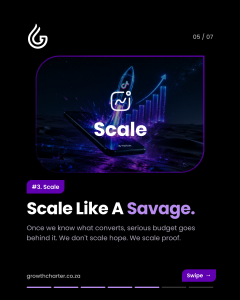 Step 3: Scale Like a Savage
We scale proof, not hope. Once a creative asset shows strong conversion maths, meaning its cost per outcome is comfortably within target, we expand in three directions.
Scaling is not the end of the process. As spend rises, fatigue approaches. That is why the engine is a loop. While one winner scales, the next test sprint is already running, so a replacement is ready before performance dips.
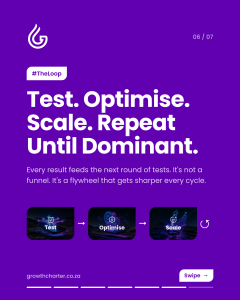
A traditional campaign has a beginning, a middle and an end. A flywheel has momentum. Each rotation of test, optimise, scale makes the next one cheaper, because you carry forward audience insight, proven hooks and a bank of winning creative.
This is also why we describe the approach as predictable. Not because any single ad is guaranteed, but because the process reliably finds what works faster than the alternative. Predictability comes from the system, not from any one idea.
To make the engine concrete, imagine a fictional online homeware brand with a single hero offer: free delivery on a starter bundle. This is illustrative, not a client case.
Days 1 to 2. The team writes one core script focused on the offer. Five hooks are drafted: a price hook, a “stop overpaying” problem hook, a before-and-after, a question and a customer reaction. Three creators are briefed.
Days 3 to 5. Creators film. Edits are kept native, with captions, natural sound and no heavy branding in the opening. Assets go live in a small-budget test across TikTok and Meta.
Days 6 to 7. The first read arrives. Two hooks hold attention clearly better than the others and one creator’s version converts at a lower cost. The bottom performers are paused. The winning hook is remixed with two alternative bodies, and a second round is queued.
By the end of the first week the brand has not just run an ad. It has a ranked list of what works, a short list of what doesn’t and a plan for week two. Compare that with waiting eight weeks for a single commercial to find out nothing.
You do not need a complicated reporting stack. A simple weekly view built around the following will do:
Review it on the same day each week and make decisions on the spot. A dashboard no one acts on is decoration.
The approach works best for brands with a clear offer and the willingness to let data overrule opinion. Retail, beauty, fragrance, financial services, recruitment and non-profit organisations have all benefited, because each has an audience that responds to specific, honest messages. It is a poor fit for teams that need every asset approved by five departments before launch, because the speed is the point.
None of this removes people from the process. Strategists choose what to test, creators bring ideas the data could never suggest and account leads decide when a pattern is real. The engine does not replace creativity. It gives creativity a fast, honest feedback loop, so good ideas get proven and weak ones get retired without a fight.
One final point on culture. The engine only works when everyone agrees, in advance, that data decides. Settle that at the start and the weekly rhythm stays calm and quick. Leave it open and every test becomes a negotiation.
 Start with a 7-day sprint
You do not need to rebuild your marketing function to begin. You need one clear offer, a handful of hooks, a few creators and the discipline to follow the data. GrowthCharter can run that first sprint for you and hand over a clear view of what your audience responds to. Talk to us about your next 7 days.