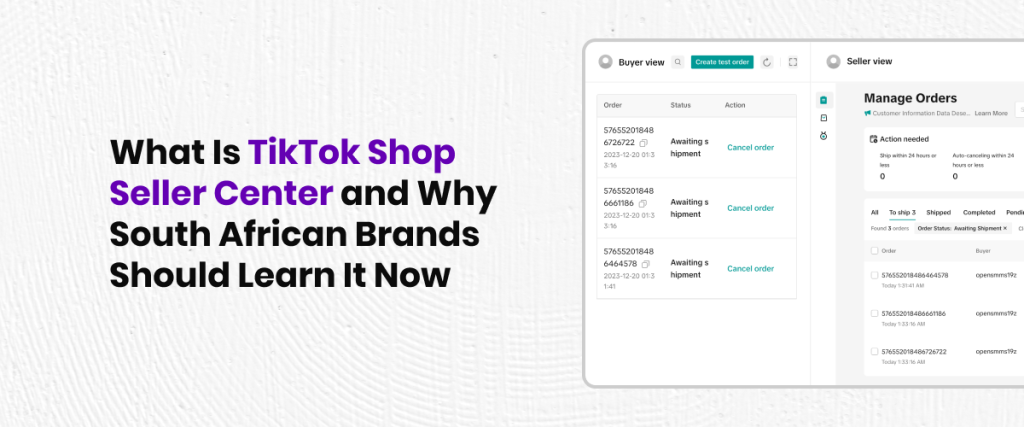
A lot of brands talk about TikTok Shop at the creative level only. Fewer understand the operator layer behind it. That is why TikTok Shop Seller Center matters. Seller Center is the hub where a business sets up its shop, verifies documents, manages store operations, handles engagement and customer service, tracks performance, and stays on top of policies (TikTok For Business, 2025). In simple terms, it is where TikTok Shop stops being a trend story and starts becoming a real operating model.
South African brands should care about Seller Center now even though TikTok Shop is not public locally yet. The reason is speed. When a new commerce product arrives, brands that already understand the system make better decisions faster. Seller Center forces teams to think about the work behind conversion: legal entity setup, business verification, warehouse and return addresses, bank details, category logic, product data, account permissions, and ongoing performance management. Those are not glamorous topics, but they are the difference between a clean launch and a messy one.
TikTok’s own setup guidance is very practical. To create a shop, a seller needs to choose a country, define the business type, verify documents, set warehouse and return addresses, and then bind a bank account before adding products (TikTok For Business, 2025). That should tell South African teams something important. TikTok Shop is not only about uploading products after the fact. It is a commercial infrastructure layer. If your business structure, operations, or data are loose, Seller Center will expose the cracks.
Seller Center also shapes what the customer sees. In live markets, linking an official account means products can appear on the profile store page and that account gains ecommerce video and LIVE permissions (TikTok For Business, 2025). That is a useful clue for South African brands. Your TikTok presence should already be moving toward clarity and commercial relevance. A future shop account cannot be built on top of an account that has no category focus, no product narrative, and no trust signals.
There is an organisational lesson here too. Seller Center is not only for the ecommerce manager. Brand, social, paid media, operations, and customer service teams all benefit from understanding what sits inside it. TikTok also lets businesses connect a TikTok Shop to Business Center for account management and access sharing (TikTok For Business, 2025). That means the commercial side of TikTok Shop will be collaborative by design. The teams that treat it like a one-person admin tool will limit themselves.
Listing quality is another reason to study Seller Center early. TikTok Shop Academy repeatedly stresses product selection, hero products, and data-led decisions in commerce growth (TikTok Shop Academy, 2025). In practice, that means titles, images, descriptions, category fit, pricing, and stock logic matter. These inputs affect discovery, creator interest, and conversion. The earlier South African brands start cleaning up product data and offer architecture, the easier it will be to adapt once Shop opens locally.
Seller Center also changes how GrowthCharter should position itself. The market does not need another agency that only talks about hooks and trends. It needs a specialist that understands how TikTok commerce actually works from content through to operations. That is why this article should point readers toward our launch checklist and our guide on how to prepare for TikTok Shop South Africa. Those pages answer the strategy question. Seller Center explains the operating layer underneath.
There is also a training benefit. Once a team understands Seller Center, conversations improve. Creators can be briefed more clearly because the team understands what a compliant product setup needs. Paid media can be planned more realistically because the team understands how product data and account permissions connect. Customer service can prepare scripts because the team understands how orders and returns will flow. In other words, Seller Center literacy makes every related decision sharper.
For South African businesses, this is especially useful because TikTok for Business tools are already available locally (TikTok Newsroom, 2022). The media side of the platform is already in market. Learning Seller Center now helps brands connect today’s audience building with tomorrow’s commerce infrastructure.
From an SEO and AEO standpoint, this topic matters because searchers who type tiktok shop seller center or tiktok shop login are usually higher intent users. They are trying to understand how the machine works. A strong article here helps GrowthCharter rank beyond broad awareness terms and into more commercial, operator-level searches. It also helps AI answer systems connect GrowthCharter with practical, high-intent TikTok Shop questions.
The key takeaway is straightforward. South African brands do not need access to TikTok Shop yet to benefit from learning Seller Center. They can study the operating model now, map the processes they will need later, and close obvious gaps before launch. That is exactly the kind of early preparation that turns future speed into a real commercial advantage.