

Author: GrowthCharter
The TikTok Agency
Author: GrowthCharter
The TikTok Agency
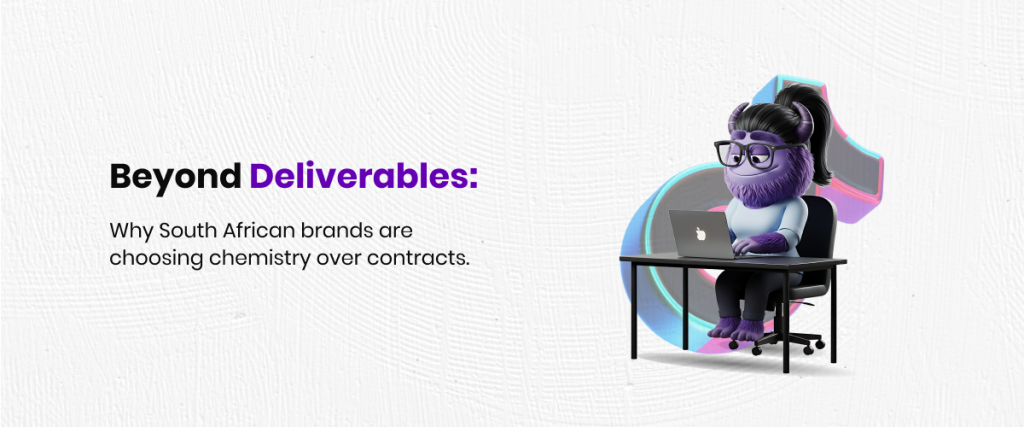
In South Africa, agency chemistry outperforms contracts. Brands grow faster when they work with agencies they trust, share data with, and collaborate with as true partners. Cultural understanding, speed, and shared accountability drive better creative, smarter media decisions, and stronger performance than any scope document alone. The contract sets the guardrails; chemistry powers the results.
South African brands don’t renew agencies because of scopes. They renew because things work.
Research from the IPA Effectiveness Databank shows that long-term, trust-based agency relationships consistently outperform short-term engagements on business growth and effectiveness metrics (https://ipa.co.uk/knowledge/publications-reports/effectiveness).
In practice, strong chemistry leads to:
Faster decisions
Braver creative
Better performance outcomes
According to WARC’s global marketing effectiveness research, high-trust partnerships enable earlier collaboration, more experimentation, and shared accountability all key drivers of performance (https://www.warc.com/).
In our market, cultural nuance matters. When brand and agency align on values, incentives, and pace, marketing stops feeling like a handover and starts behaving like a shared mission. Chemistry beats contracts because trust unlocks speed. Speed unlocks learning. Learning unlocks performance.
Chemistry isn’t vibes. It’s behaviour.
Strong partnerships show up as:
Shared outcomes, not just task lists
Open data access and transparent dashboards
Fast feedback loops on creative and media
Respect for local language, humour, and context
Honest trade-offs between budget, timelines, and impact
McKinsey’s work on agile marketing organisations shows that cross-functional, trust-based teams improve speed-to-market by up to 30% and significantly outperform siloed models (https://www.mckinsey.com/capabilities/growth-marketing-and-sales/our-insights/agile-marketing).
That’s not a tooling problem. That’s a trust problem, solved by chemistry.
South Africa is not one market. It’s many layered, emotional, and context-heavy. According to Think with Google’s Sub-Saharan Africa insights, locally adapted creative consistently outperforms global, generic messaging because it reflects lived cultural realities (https://www.thinkwithgoogle.com/intl/en-ssa/).
Agencies that live this context understand:
Multiple languages and cultural codes
Regional price sensitivities and adoption curves
Retail, franchise, and informal trade dynamics
Local moments global playbooks miss
Cultural fluency isn’t optional here. It’s a performance multiplier.
You know chemistry exists when:
Strategy sessions feel like one team, not two sides
Weekly reviews connect spend to outcomes, not activity
Creative testing is continuous, not campaign-based
WhatsApp and email responses are fast, clear, and human
Hard news is shared early with options, not excuses
Harvard Business Review’s research on psychological safety shows that teams with high trust make better decisions under pressure and adapt faster to change (https://hbr.org/2018/01/what-psychological-safety-looks-like-in-a-healthy-team).
That safety starts with chemistry.
If trust feels abstract, build it deliberately:
Define one commercial goal for the next quarter
Agree on three primary metrics and two guardrails
Share source data, not just slides
Test small, scale winners, and document learning
Run a monthly retro with actions, owners, and deadlines
This mirrors performance-led marketing best practice outlined in WARC’s effectiveness frameworks, where learning velocity is directly tied to growth (https://www.warc.com/).
Discovery
Market, channels, message, offer, constraints
Design
Creative angles grounded in South African culture
Delivery
Media with daily pacing, caps, and optimisation
Diagnostics
Dashboards tied to revenue, leads, or pipeline
Decisions
Keep. Kill. Scale. Based on evidence not ego
This structure supports continuous learning, not campaign dependency.
Let’s be clear contracts matter.
They provide:
Scope control and governance
Pricing clarity and approval rules
Legal, compliance, and risk protection
But a contract is a guardrail. It does not create momentum. Chemistry is the engine.
Ask questions that test partnership depth:
How will you connect media, creative, and conversions?
How will you adapt a global idea for local audiences?
What will you do in the first 30, 60, and 90 days?
What decisions will you make if performance dips?
How will we measure trust and effectiveness over time?
These questions surface thinking, not pitch decks.
Faster launches and iteration cycles
Clear creative winners by audience cluster
Lower acquisition costs and higher lead quality
Better sales handoff and feedback
Fewer surprises in the board report
As reinforced by IPA and WARC effectiveness studies, long-term partnerships outperform short-term engagements because trust compounds learning over time (https://ipa.co.uk/knowledge/publications-reports/effectiveness, https://www.warc.com/).
Contracts protect the relationship. Chemistry grows the business. In South Africa, where culture moves fast and nuance matters, the brands that win don’t just hire agencies. They build partnerships.

Author: GrowthCharter
The TikTok Agency
Author: GrowthCharter
The TikTok Agency

Author: GrowthCharter
The TikTok Agency