

Author: GrowthCharter
The TikTok Agency
Author: GrowthCharter
The TikTok Agency
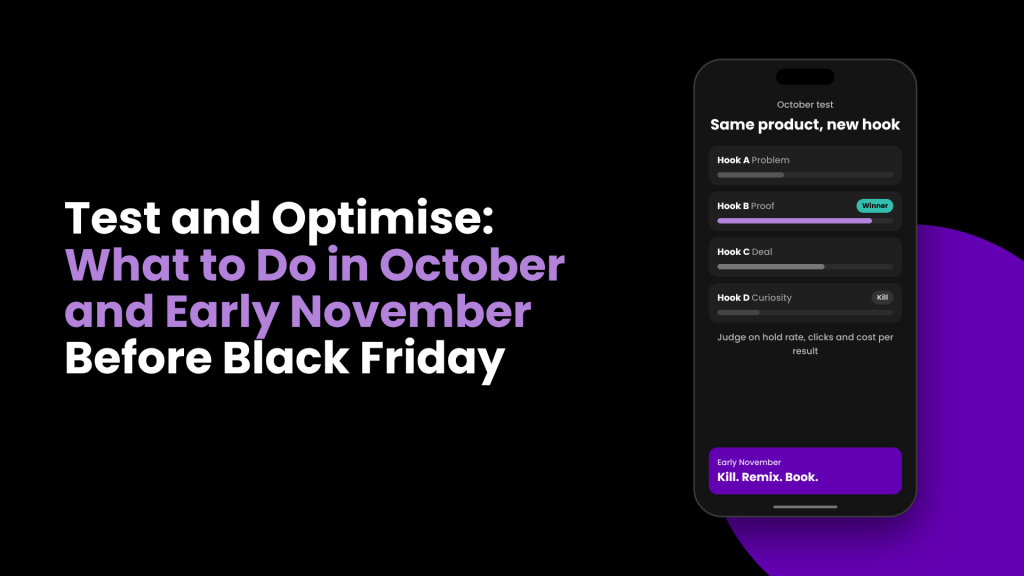
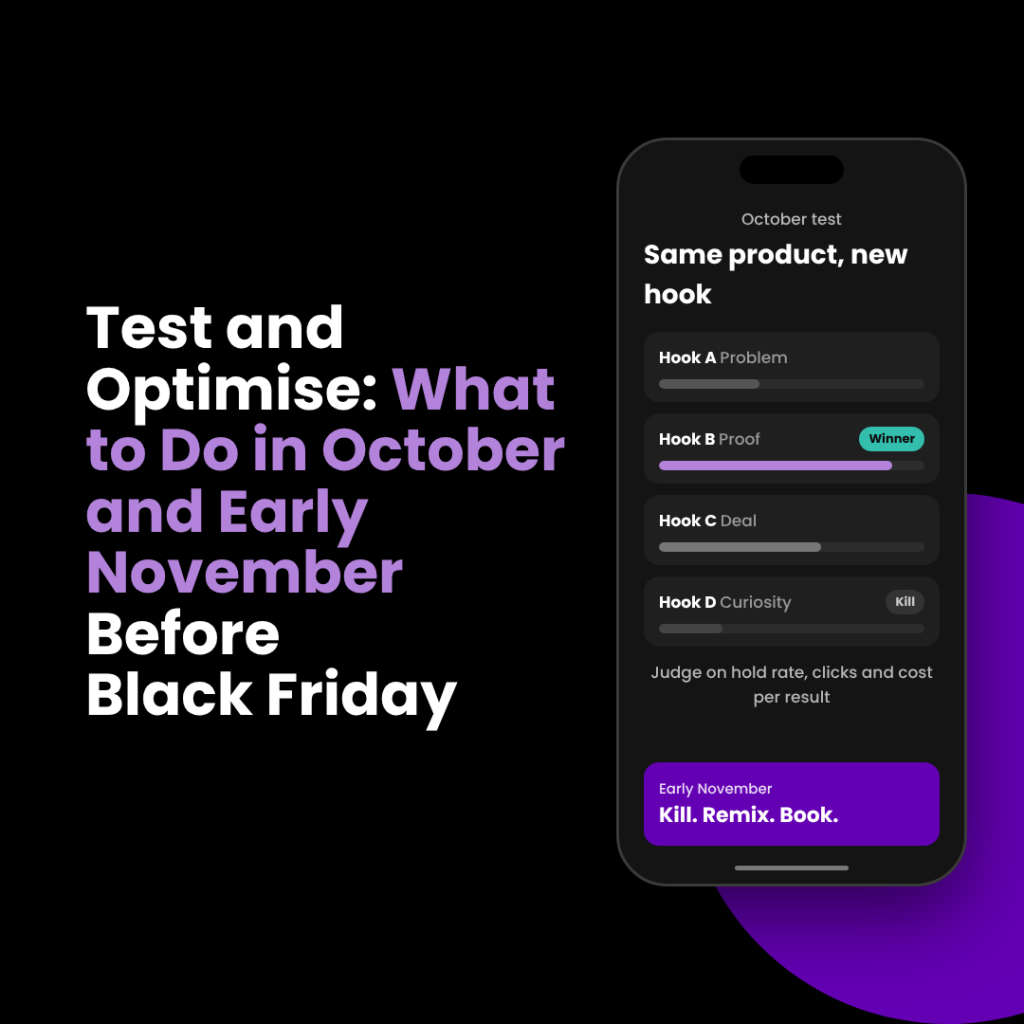
October is for testing. Launch three to five hooks on one product, brief a few creators, and test bundles, upgrades and add-ons against a straight discount. Know your break-even ROAS before you commit to any offer: divide one by your margin after the discount. 1 to 15 November is for optimising. Kill what flopped, remix what nearly worked, confirm creators in writing and rehearse your TikTok LIVE. Everything you prove here is what you scale from 16 November. That is call three.
Black Friday is won in October.
Not on the day. Not in the week. In the quiet weeks before, when the auction is calmer and every test costs less. The brands that win on 27 November walk in already knowing which hook stops the scroll, which creator moves product and which offer pays for its own ads.
This guide covers calls one and two of our Black Friday game plan: Test in October, then Optimise in the first half of November.
Every brand piles in at the same time, chasing the same thumbs. Costs climb, and untested ads burn the most.
How much costs climb depends on whom you ask. Some benchmarks put Q4 CPM increases at 30% to 65%, with Black Friday and Cyber Monday close to double the rest of the year, while others suggest 20% to 40%. The direction is the same either way.
Retailers are also starting earlier. FNB reported that in 2024, spending in the week before Black Friday rose 25%, up from 7% the year before, with promotions released sooner again. By the time the date arrives, shoppers have already been deciding for weeks.
So the question is not whether to spend in peak week. It is whether you spend on things you already know work.
Start this week. Take one hero product and launch three to five versions of the same ad where only the opening changes. Same body, same offer, same call to action. That way, when one wins, you know why.
The first two seconds decide whether anyone sees the rest, which makes the hook the cheapest and most valuable thing you will ever test. Five angles worth trying:
Judge them on hold rate (how many people watch past the first few seconds), click-through rate and cost per result. Views alone will lie to you. A hook that earns attention but no clicks is entertainment, not conversion.
Brief three or four creators with the same product, the same objective and the same deadline, then compare like for like. You are looking for three things: an audience that matches yours, content that feels native to the feed, and the ability to make people act.
Ask each creator for a few variations rather than one polished video. Those spare cuts become your fresh creative in Black Friday week, when your first ads start to tire.
South African shoppers are spending, but carefully. PayJustNow describes a more intentional, disciplined Black Friday, where people buy but do not overextend. A bare percentage off gives them very little reason to choose you over the next brand shouting the same number.
Test a straight discount against three value offers:
Your break-even ROAS tells you how much revenue each R1 of ad spend must bring back before you make a cent. The formula is simple: one divided by your margin after the discount. This break-even figure is the foundation of Q4 budgeting. Use figures excluding VAT, and count every cost per order: product, packaging, delivery subsidy and payment fees.
Here is how a discount and a bundle compare for the same serum:
| 30% off one serum | Two-serum bundle at 20% off | |
|---|---|---|
| Normal price | R500 | R1,000 |
| Sale price | R350 | R800 |
| Cost per order | R203 | R406 |
| Profit before ads | R147 | R394 |
| Margin after discount | 42% | 49% |
| Break-even ROAS | 2.38 | 2.03 |
The bundle gives the shopper a bigger headline saving in rands, earns you more per order and needs less from every ad to break even. That is the kind of offer that survives a bidding war. Set your target ROAS comfortably above break-even so there is room for actual profit.
Anything that has spent a fair amount without clearing break-even gets switched off. A useful rule of thumb: if an ad has spent two to three times your target cost per purchase with nothing to show for it, it is not going to surprise you. Testing only pays if you stop funding the weak.
A near-miss is not a loser. It is a remix waiting to happen:
Winners tire too, because creative fatigue pushes costs up and slows delivery. The remixes you make in early November are the fresh creative you swap in during Black Friday week.
The best South African creators book out before November. Hold dates in October, then confirm the creators your tests favoured, in writing, by 6 November: dates, deliverables, usage rights and how long you can run their content as ads.
LIVE is where Black Friday attention turns into action, so treat it as a show, not a stream. Plan four things: hosts (who is on camera and who backs them up), run-of-show (a clear order, led by your proven winners), offers (timed drops that give people a reason to stay) and moderation (one person owning comments, with answers to common objections ready).
Here is a 60-minute run-of-show you can steal:
| Time | What happens |
|---|---|
| 0:00 to 0:05 | Big opening. Tell viewers exactly what is dropping and when, so they stay. |
| 0:05 to 0:20 | Spotlight your top proven winner. Demo it, answer questions live. |
| 0:20 | Drop one: a timed offer with the code on screen. |
| 0:25 to 0:40 | Spotlight products two and three. Show real reactions and reviews. |
| 0:40 | Drop two: the bundle or the free extra. |
| 0:45 to 0:55 | Objection round. Delivery times, sizing, returns, payment options. |
| 0:55 to 1:00 | Final call, recap the codes and tease your next LIVE. |
One South African reality check: until TikTok Shop is live here, viewers cannot check out inside the stream. Make the path to purchase impossible to miss. Show a short, memorable URL and an offer code on screen, update your link in bio, and have your moderator repeat both in the comments every few minutes.
Rehearse at least once. Check lighting, audio and connection, and confirm stock so you never promote something you cannot ship.
Gupta Media’s analysis of 2022 data found that TikTok CPMs dipped in early November while shopper intent was already rising. That is one year of data, so check it against your own account. But it supports the whole logic of this plan: learn while it is cheap, then spend when it counts.
| Dates | Focus |
|---|---|
| Now to 31 October | Test hooks, creators and offers. Hold creator dates. Work out break-even ROAS. |
| 1 to 6 November | Kill and remix. Confirm creators in writing. |
| 7 to 15 November | Build creative variations. Rehearse your LIVE. Confirm stock and checkout. |
| 16 to 30 November | Scale what you proved. Here is how. |
Not sure you are on track? Run through the five warning signs before you go any further.
Onboarding with GrowthCharter closes on 6 November. Our free Black Friday Readiness Audit checks your hooks, creators, LIVE plan, offer and checkout, and tells you what to fix first.
Author: GrowthCharter
The TikTok Agency
Author: GrowthCharter
The TikTok Agency
Author: GrowthCharter
The TikTok Agency